
When businesses think about improving their SEO, they usually focus on publishing quality content, targeting the right keywords, and building backlinks. While these are all essential, there’s another powerful optimization technique that often goes unnoticed – Schema Markup.
Unlike content or design updates, schema markup isn’t visible to your website visitors. Instead, it works behind the scenes, helping search engines understand your content more accurately. As search engines and AI-powered platforms continue to evolve, structured data has become an essential part of technical SEO.
In my experience as a digital marketer, I’ve found that many websites have excellent content but fail to implement schema markup. That means search engines may not fully understand what each page represents, potentially missing opportunities to display enhanced search results.
What Is Schema Markup?
Schema Markup is a standardized form of structured data that gives search engines additional information about your webpages. Rather than leaving search engines to interpret your content on their own, schema clearly defines what your page is about.
For example, schema markup can identify whether a page is:
- A blog article
- A service page
- A product
- A local business
- A frequently asked questions page
- An event
- A review
- A person’s profile
This extra context helps search engines organize, interpret, and present your content more effectively.
Why Is Schema Markup Important for SEO?
Search engines aim to deliver the most relevant and trustworthy information to users. The better they understand your website, the more accurately they can match it with search queries.
Although schema markup isn’t a direct ranking factor, it offers several valuable benefits:
- Helps search engines understand your content.
- Increases eligibility for rich search results.
- Can improve click-through rates (CTR).
- Strengthens your technical SEO.
- Supports AI-powered search experiences.
Think of schema markup as providing a roadmap that makes it easier for search engines to interpret your website.
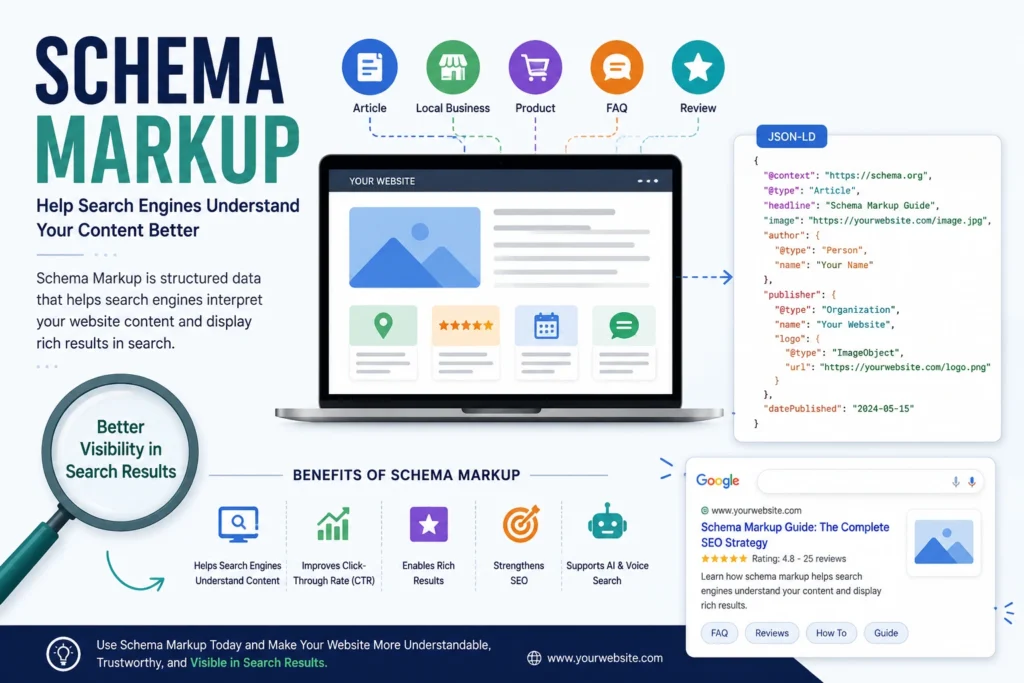
How Schema Markup Improves Search Visibility
One of the biggest advantages of implementing structured data is the opportunity to qualify for rich results.
Depending on your content, search engines may display:
- FAQ sections
- Breadcrumb navigation
- Business details
- Product information
- Review ratings
- Article details
- Event information
These enhanced listings make your search results more informative and can attract more clicks than standard listings.
Common Types of Schema Markup
Organization Schema
Ideal for businesses and agencies, this schema provides information such as your business name, logo, website, and social profiles.
Person Schema
Perfect for consultants, freelancers, and professionals building a personal brand.
Local Business Schema
Designed for businesses that serve specific geographic areas. It includes details such as your address, contact information, business hours, and location.
Service Schema
Describes the services your business offers, making it easier for search engines to understand your expertise.
Article Schema
Used for blog posts to provide information such as the author, publication date, headline, and featured image.
FAQ Schema
Allows search engines to understand the frequently asked questions displayed on your webpage.
Breadcrumb Schema
Helps search engines understand your website’s navigation structure while improving user experience.
Schema Markup and AI Search
Search is changing rapidly with the growth of AI-powered search engines and conversational assistants.
These systems rely on structured information to understand content more effectively.
Schema Markup helps AI identify:
- Who created the content
- What the webpage discusses
- Which services are offered
- How pages are connected
- The overall context of your website
This makes structured data an important part of both traditional SEO and AI search optimization.
Best Practices for Schema Markup
To get the best results:
- Use JSON-LD whenever possible.
- Apply schema that accurately reflects your page content.
- Ensure all marked-up information is visible to users.
- Keep your business information consistent.
- Validate your schema before publishing.
- Update your structured data whenever your content changes.
Common Mistakes to Avoid
Many websites miss opportunities because they:
- Add FAQ schema without visible FAQs.
- Use incorrect schema types.
- Leave outdated business information.
- Forget to validate their structured data.
- Apply multiple conflicting schemas.
Regularly reviewing your structured data helps maintain accuracy.
Frequently Asked Questions
Does Schema Markup improve Google rankings?
Schema Markup is not a direct ranking factor, but it helps search engines understand your content better and may improve your visibility through rich results.
Which Schema type should I use?
It depends on your page. A blog should use Article schema, a service page should use Service schema, and pages with visible FAQs can use FAQ schema.
What is JSON-LD?
JSON-LD is Google’s recommended format for implementing structured data because it’s easier to maintain and keeps your website code cleaner.
How can I test Schema Markup?
You can validate your structured data using Google’s Rich Results Test or the Schema Markup Validator before publishing.
Conclusion
Schema Markup may not be something your visitors can see, but it plays a crucial role in how search engines and AI systems understand your website.
If you’re already investing in quality content, keyword research, and technical SEO, implementing structured data is the next logical step. It improves how your website communicates with search engines, supports enhanced search results, and helps prepare your site for the future of AI-driven search.